Best SEO Tools in 2026: Ahrefs vs Writesonic vs ContentStudio vs Semrush
Table of Contents
The SEO Tool Problem Nobody Wants to Admit
At a Glance: 2026 Feature Comparison
Ahrefs: Still the SEO Benchmark, but Not for Everyone
Writesonic: AI Content Engine with SEO Wiring Built In
ContentStudio: Built for Social, Not SEO
Semrush: The Full-Suite Alternative to Ahrefs
Which Tool Actually Wins in 2026?
Using AI SEO Content Without Getting Flagged
Bottom Line
The SEO Tool Problem Nobody Wants to Admit
You're searching for the best SEO tool in 2026, and you're getting the same recycled listicle with the same five tools in the same order. The problem is that most of those lists were written by people who haven't actually run a content operation at scale. They haven't had to justify a $129/month Ahrefs seat to a skeptical CFO, or watched a ContentStudio queue misfire and send LinkedIn posts at 3am.
This comparison covers four tools that show up repeatedly in real SEO workflows right now: Ahrefs, Writesonic, ContentStudio, and Semrush. They're not interchangeable. They serve different functions, and picking the wrong one wastes both money and time.
One thing worth flagging upfront: if your SEO content pipeline runs on AI-generated drafts, detection risk is a real variable. How to write undetectable AI SEO-optimized blogs that will rank covers the full strategy for keeping AI-assisted content clean and ranking.
At a Glance: 2026 Feature Comparison
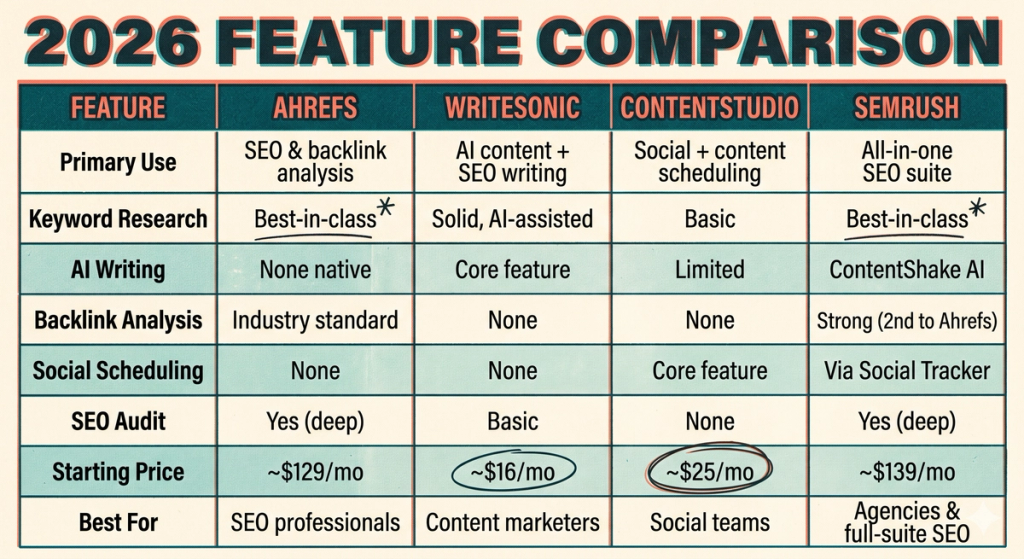
Now to what the table can't tell you.
Ahrefs: Still the SEO Benchmark, but Not for Everyone
Ahrefs is the closest thing the SEO industry has to a shared standard. If you're doing competitive research, link gap analysis, or trying to understand why a page dropped after a core update, it's the first place most professionals go. The keyword explorer is deep, the Site Audit tool is thorough, and the backlink index is genuinely difficult to replicate.
The catch is the price and the learning curve. At $129/month minimum for a solo seat, it's a significant commitment for a small team or a freelancer. And many of its best features (Content Gap, Link Intersect, historical data) require time to learn before they pay off.
Where Ahrefs falls short in 2026: it still has no native AI writing capability. The platform's philosophy has always been data over content generation, which is a defensible position, but it means you're paying for analysis and doing production work elsewhere. If your bottleneck is publishing volume rather than keyword strategy, Ahrefs alone won't move the needle.
Ahrefs' own confirmed Google ranking factors guide is worth reading regardless of which tool you use, since it clarifies what the platform was built around: backlinks, content quality, and search intent matching.
Writesonic: AI Content Engine with SEO Wiring Built In
Writesonic in 2026 is a materially different product from what it was in 2023. The keyword research integration is functional (not Ahrefs-level, but usable), and the AI writing quality has improved enough that it can produce first drafts that don't require a full rewrite to publish.
The competitive angle is the price-to-output ratio. At around $16/month for the starter tier, it's accessible to solo operators who need to generate content volume without a full editorial team. The AI article writer can take a keyword and produce a structured draft in a few minutes, which is legitimately useful if you're managing 20+ articles per month.
The limitation is accuracy. Writesonic doesn't verify facts, and its AI drafts will sometimes cite figures that don't check out. For any article touching statistics, case studies, or technical claims, you need a human editing pass. Publishing unverified AI stats is a faster way to lose E-E-A-T signals than almost anything else.
On the AI detection side: Writesonic drafts tend to read as AI-generated when run through modern detectors, because the platform doesn't humanize by default. If you're running content at scale through Writesonic, pairing it with StealthGPT's AI rewriter before publishing is a real workflow consideration. Detection flags on content can suppress rankings regardless of keyword quality.
The broader context: according to Orbit Media's annual content marketing survey, AI adoption among content marketers went from 65% to 95% in two years. The question isn't whether to use AI writing tools. It's which ones fit your production process and what you do with the output.
ContentStudio: Built for Social, Not SEO
ContentStudio is frequently compared to SEO tools, but that comparison isn't quite right. It's a social media scheduling and content curation platform. Its core strength is letting you manage multiple social accounts, discover trending content, and maintain a publishing calendar across LinkedIn, Instagram, Twitter/X, and Facebook from one interface.
The SEO utility is limited to content discovery: you can find trending articles in your niche and use them as source material for posts. It doesn't do keyword research, backlink analysis, or on-page auditing. If you're evaluating ContentStudio as a direct alternative to Ahrefs or Writesonic, you're comparing different categories.
Where ContentStudio earns its seat is in social amplification of SEO content. You write the article, and ContentStudio handles the distribution layer. For content teams that produce blog posts and then want a systematic way to repurpose and schedule snippets across social channels, it fits cleanly into that workflow. Starting around $25/month, it's affordable enough to run alongside a dedicated SEO tool rather than instead of one.
Semrush: The Full-Suite Alternative to Ahrefs
Semrush is the only tool on this list that directly competes with Ahrefs for the same budget and the same user. Both platforms cover keyword research, backlink analysis, site auditing, rank tracking, and competitive intelligence. The pricing is nearly identical, hovering around $139/month at the entry tier.
Where Semrush differentiates is breadth. The platform includes tools that Ahrefs doesn't: a full advertising research module, a social media tracker, a local SEO toolkit, and ContentShake AI, its built-in AI writing assistant. If you're running an agency or managing SEO for multiple clients across different channels, Semrush gives you more of those workflows in one place.
The case for Ahrefs over Semrush usually comes down to backlink data quality and keyword index depth. Ahrefs' crawler is widely considered more thorough for link analysis. Semrush's keyword database is larger by raw count, but practitioners who work with both platforms regularly report that Ahrefs surfaces cleaner, more actionable data for competitive keyword research.
Semrush's ContentShake AI is worth noting separately. It generates SEO-optimized drafts with keyword suggestions built in, which is a genuine time-saver for teams that don't want to run a separate AI writing tool. The output quality is comparable to Writesonic, which means it carries the same caveat: the drafts read as AI-generated without a humanization step, and publishing them raw is a ranking risk.
Which Tool Actually Wins in 2026?
The honest answer: there's no single winner because these tools don't actually compete with each other.
Ahrefs wins on technical SEO depth. If you're running keyword research, analyzing competitors' backlink profiles, and diagnosing ranking drops, nothing else on this list touches it.
Writesonic wins on content production volume. If you're building out a blog at scale and need AI drafts as starting points, it's the most complete option at its price tier.
Semrush wins on all-in-one coverage. Agencies managing multiple clients across SEO, paid search, and social will get more out of Semrush's breadth than Ahrefs' depth. ContentShake AI also makes it a contender for teams that want writing and research in the same platform.
ContentStudio wins on social distribution. If you have an existing content operation and need a cleaner way to repurpose and schedule posts across platforms, it fills that gap without overlap.
The pattern worth noting: all of the tools that touch AI content generation (Writesonic especially) output text that reads as machine-generated by default. Google's helpful content guidelines increasingly reward content that demonstrates genuine expertise, not just keyword targeting. That means AI-generated drafts need editing, humanization, and a visible point of view before they're ready to publish.
Using AI SEO Content Without Getting Flagged
The real variable that most SEO tool comparisons skip over in 2026 is AI detection. Google's quality raters are explicitly trained to flag low-value AI content, and several AI detector platforms now score Writesonic output as high-probability AI text on the first pass.
StealthGPT's SEO rewriter is built specifically for this use case: taking AI-generated SEO content and restructuring it to pass detection while keeping the keyword targeting intact. It's the missing step in most AI content workflows.
If you're building a 2026 SEO content operation, the practical stack looks like this: Ahrefs or a keyword tool for research, Writesonic or a comparable AI writer for draft production, and StealthGPT for detection-proofing before publish. That combination keeps output volume high without the ranking penalties that come from publishing raw AI text.
Start with the StealthGPT SEO rewriter. No credit card required for the free tier.
Bottom Line
Ahrefs is the SEO professional's tool. Semrush is the agency suite. Writesonic is the content producer's tool. ContentStudio is the social scheduler. None of them are the same product. Pick the one that matches your actual bottleneck.
And if AI content generation is part of your process, add a humanization and detection-proofing step before anything goes live. The StealthGPT blog has more on building content pipelines that rank.
